Simulation grids (simqso.sqgrids)
Introduction
simqso.sqgrids provides classes for managing “points” (quasars) in a
simulation. A collection of points is referred to as a grid, although they
are not required to be uniformly distributed.
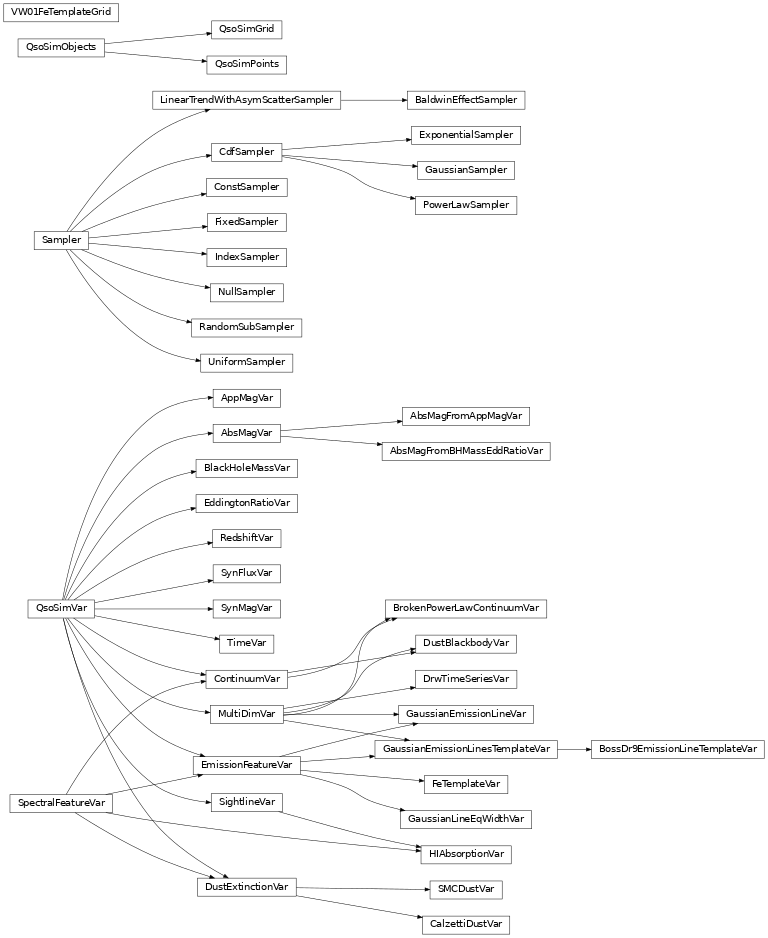
simqso.sqgrids.QsoSimObjects is the base container class for QSO grids. Objects can be
distributed in a regular grid (simqso.sqgrids.QsoSimGrid), or not, e.g. according to a
luminosity function (simqso.sqgrids.QsoSimPoints).
Each point is defined by a set of variables (simqso.sqgrids.QsoSimVar). The simplest
descriptive variables are absolute magnitude (simqso.sqgrids.AbsMagVar), apparent
magnitude (simqso.sqgrids.AppMagVar), and redshift (simqso.sqgrids.RedshiftVar). Variables that inherit
from simqso.sqgrids.SpectralFeatureVar define a function simqso.sqgrids.SpectralFeatureVar.add_to_spec() that knows how
to apply the variable to a spectrum. Variables can be multidimensional
(simqso.sqgrids.MultiDimVar), e.g., simqso.sqgrids.BrokenPowerLawContinuumVar has an extra dimension
to account for the set of power-law slopes defining the full continuum.
Each variable must know how to be randomly sampled to produce a given
realization of the simulation. Thus they are instantiated with a simqso.sqgrids.Sampler
instance, which defines how to produce n samples of the variable.
Basic samplers include simqso.sqgrids.UniformSampler which uniformly distributes values
between two bounds, and simqso.sqgrids.ConstSampler which sets all values to be a single
constant. Many samplers inherit from simqso.sqgrids.CdfSampler, which means values are
drawn from a cumulative distribution function. For example, simqso.sqgrids.GaussianSampler,
simqso.sqgrids.ExponentialSampler, and simqso.sqgrids.LogNormalSampler all generate points sampled from
the cdf of the eponymous function.
A simple tutorial for working with samplers, variables, and grids is provided in https://github.com/imcgreer/simqso/blob/master/examples/GridExamples.ipynb.
Reference/API
-
class
simqso.sqgrids.Sampler(low, high)[source]¶ Bases:
objectBase class for sampling one-dimensional values within a given bound.
Subclasses must define the sample() function.
Parameters: - low,high : float
Lower and upper bounds for the sampler.
-
class
simqso.sqgrids.FixedSampler(vals)[source]¶ Bases:
simqso.sqgrids.SamplerUse a fixed set of values as the sample.
>>> from simqso.sqgrids import FixedSampler
>>> s = FixedSampler([1.,2.,3.])
>>> s(3)
[1.0, 2.0, 3.0]
-
class
simqso.sqgrids.NullSampler[source]¶ Bases:
simqso.sqgrids.SamplerSpecial container for variables which are not sampled.
-
class
simqso.sqgrids.IndexSampler[source]¶ Bases:
simqso.sqgrids.SamplerSpecial container for variables which need an index into the grid.
-
class
simqso.sqgrids.RandomSubSampler(n)[source]¶ Bases:
simqso.sqgrids.Sampler
-
class
simqso.sqgrids.ConstSampler(*val)[source]¶ Bases:
simqso.sqgrids.SamplerReturns a constant for all samples.
>>> from simqso.sqgrids import ConstSampler
>>> s = ConstSampler(17)
>>> s(3)
array([17, 17, 17])
-
class
simqso.sqgrids.UniformSampler(low, high)[source]¶ Bases:
simqso.sqgrids.SamplerReturns values uniformly sampled between
lowandhigh, inclusive.>>> from simqso.sqgrids import UniformSampler >>> s = UniformSampler(0,1) >>> s(3) array([ 0. , 0.5, 1. ])
-
class
simqso.sqgrids.CdfSampler(low, high)[source]¶ Bases:
simqso.sqgrids.SamplerReturns values sampled from a cumulative distribution function, within the bounds passed during instantiation.
Subclasses must implement the cdf(x) and ppf(x) functions.
Parameters: - low,high : float
Lower and upper bounds for the sampler.
-
class
simqso.sqgrids.PowerLawSampler(low, high, a)[source]¶ Bases:
simqso.sqgrids.CdfSamplerReturns values sampled from a power law distribution with index a.
Unlike scipy.stats.powerlaw, allows a<0, but then requires low>0 in that case.
Examples
>>> from simqso.sqgrids import PowerLawSampler
>>> s = PowerLawSampler(1,2,-2)
>>> s(3)
array([ 1.4537,  1.1208,  1.1691])
-
class
simqso.sqgrids.GaussianSampler(mean, sigma, low=-inf, high=inf)[source]¶ Bases:
simqso.sqgrids.CdfSamplerReturns values sampled from a Gaussian distibution N(mean,sigma).
Examples
>>> from simqso.sqgrids import GaussianSampler
>>> s = GaussianSampler(50.,10.)
>>> s(3)
array([ 50.07  ,  42.0223,  58.9512])
-
class
simqso.sqgrids.ExponentialSampler(scale, low=0, high=inf)[source]¶ Bases:
simqso.sqgrids.CdfSamplerReturns values sampled from an exponential distibution with a given scale parameter.
Examples
>>> from simqso.sqgrids import ExponentialSampler
>>> s = ExponentialSampler(0.1)
>>> s(3)
array([ 0.08072409,  0.45771082,  0.03769428])
-
class
simqso.sqgrids.LinearTrendWithAsymScatterSampler(coeffs, pts, low=-inf, high=inf)[source]¶ Bases:
simqso.sqgrids.SamplerReturns values sampled from a set of linear trends that define the Gaussian mean and sigma at each point x.
Must be calibrated with a set of input points that define where to sample the linear trends.
-
class
simqso.sqgrids.BaldwinEffectSampler(coeffs, absMag, x=None, low=-inf, high=inf)[source]¶ Bases:
simqso.sqgrids.LinearTrendWithAsymScatterSamplerUses LinearTrendWithAsymScatterSampler to implement the Baldwin Effect, by sampling from mean, upper, and lower log-linear trends as a function of absolute magnitude.
-
class
simqso.sqgrids.QsoSimVar(sampler, name=None, seed=None, meta=None)[source]¶ Bases:
objectBase class for variables used to define points within simulation grid. Each variable must have a name and a Sampler instance for generating values of the variable.
Parameters: - sampler :
simqso.sqgrids.Samplerinstance - name : str
Unique name for variable.
- seed : int
Seed to apply to RNG before sampling the variable. If None there is no call to random.seed().
-
resample(*args, **kwargs)[source]¶ Update the samplers of any dependent variables and then resample.
- sampler :
-
class
simqso.sqgrids.MultiDimVar(sampler, name=None, seed=None, meta=None)[source]¶ Bases:
simqso.sqgrids.QsoSimVarSpecial case of QsoSimVar that handles multi-dimensional variables. The last dimension must be a sequence of Sampler instances, which can be nested in as many outer dimensions as necessary.
-
class
simqso.sqgrids.SpectralFeatureVar[source]¶ Bases:
objectMix-in class to define variables that act on spectra.
Subclasses must define the render() function.
-
add_to_spec(spec, par, **kwargs)[source]¶ Applies the variable to an input spectrum.
Parameters: - spec :
simqso.sqbase.Spectruminstance - par : sampled values of the variable that are passed to render()
- spec :
-
-
class
simqso.sqgrids.AppMagVar(sampler, obsBand, **kwargs)[source]¶ Bases:
simqso.sqgrids.QsoSimVarAn apparent magnitude variable, defined in an observed bandpass
band.
-
class
simqso.sqgrids.AbsMagVar(sampler, restWave=None, **kwargs)[source]¶ Bases:
simqso.sqgrids.QsoSimVarAn absolute magnitude variable, defined at rest-frame wavelength
restWavein Angstroms.
-
class
simqso.sqgrids.RedshiftVar(sampler, name=None, seed=None, meta=None)[source]¶ Bases:
simqso.sqgrids.QsoSimVarA redshift variable.
-
class
simqso.sqgrids.ContinuumVar(sampler, name=None, seed=None, meta=None)[source]¶ Bases:
simqso.sqgrids.QsoSimVar,simqso.sqgrids.SpectralFeatureVarBase class for variables that define the quasar spectral continuum.
-
class
simqso.sqgrids.BrokenPowerLawContinuumVar(samplers, breakPts, **kwargs)[source]¶ Bases:
simqso.sqgrids.ContinuumVar,simqso.sqgrids.MultiDimVarRepresentation of a quasar continuum as a series of broken power laws.
Parameters: - samplers : sequence of
simqso.sqgrids.Samplerinstances Each sampler instance defines the power law spectral index at a given section of the continuum, as alpha_nu where f_nu = nu^alpha_nu.
- breakPts : sequence of floats
Break wavelengths in Angstroms.
Examples
>>> from simqso.sqgrids import BrokenPowerLawContinuumVar,GaussianSampler
>>> v = BrokenPowerLawContinuumVar([GaussianSampler(-1.5,0.3),
                                    GaussianSampler(-0.5,0.3)],
                                   [1215.7])
>>> v(3)
array([[-1.801, -1.217],
       [-1.56 , -0.594],
       [-1.605, -0.248]])
-
render(wave, z, slopes, fluxNorm=None, assocvals=None)[source]¶ Renders the broken power law continuum at redshift
zgiven the set of sampledslopes. Aribrarily normalized unless thefluxNormparameter is supplied.Parameters: - fluxNorm : dict
- wavelength : float
rest-frame wavelength in Angstroms at which to normalize spectrum.
- M_AB : float
absolute AB magnitude at
wavelength
DM : function to return distance modulus, as in
DM(z)
- samplers : sequence of
-
class
simqso.sqgrids.EmissionFeatureVar(sampler, name=None, seed=None, meta=None)[source]¶ Bases:
simqso.sqgrids.QsoSimVar,simqso.sqgrids.SpectralFeatureVarBase class for variables that define quasar spectral emission features.
-
class
simqso.sqgrids.GaussianEmissionLineVar(sampler, name=None, seed=None, meta=None)[source]¶ Bases:
simqso.sqgrids.EmissionFeatureVar,simqso.sqgrids.MultiDimVarA single Gaussian emission line. Must be instantiated with three samplers for the profile, namely (wavelength, equivalent width, sigma). All parameters are given in the rest-frame and in Angstroms.
Examples
>>> from simqso.sqgrids import GaussianEmissionLineVar
>>> v = GaussianEmissionLineVar([GaussianSampler(1215.7,0.1),GaussianSampler(100.,10.),GaussianSampler(10.,1.)])
>>> v(3)
array([[ 1215.645,   113.125,     9.099],
       [ 1215.987,   109.654,     9.312],
       [ 1215.74 ,   101.765,    10.822]])
-
class
simqso.sqgrids.GaussianLineEqWidthVar(sampler, name, wave0, width0, log=False, **kwargs)[source]¶ Bases:
simqso.sqgrids.EmissionFeatureVarthis is an arguably kludgy way of making it possible to include line EW as a variable in grids, by reducing the line to a single parameter
Parameters: - sampler :
simqso.sqgrids.Samplerinstance Sampler for generating equivalent width values.
- name : str
Name of emission line.
- wave0,width0 : float
Fixed Gaussian parameters for the rest-frame wavelength and sigma in Angstroms. Only the equivalent width is sampled.
- sampler :
-
class
simqso.sqgrids.GaussianEmissionLinesTemplateVar(sampler, name=None, seed=None, meta=None)[source]¶ Bases:
simqso.sqgrids.EmissionFeatureVar,simqso.sqgrids.MultiDimVarA multidimensional variable representing a template of Gaussian-profile emission lines.
-
class
simqso.sqgrids.BossDr9EmissionLineTemplateVar(samplers, lineNames=None, **kwargs)[source]¶ Bases:
simqso.sqgrids.GaussianEmissionLinesTemplateVarSubclass of GaussianEmissionLinesTemplateVar that obtains log-linear trends for the emission lines from the BOSS DR9 model (Ross et al. 2013). TODO: this should really start with the file
-
class
simqso.sqgrids.FeTemplateVar(feGrid=None, **kwargs)[source]¶ Bases:
simqso.sqgrids.EmissionFeatureVarVariable used to store an iron emission template, and then render it at an input redshift.
Since the template is fixed it uses a
simqso.sqgrids.NullSamplerinstance internally.
-
class
simqso.sqgrids.DustBlackbodyVar(*args, **kwargs)[source]¶ Bases:
simqso.sqgrids.ContinuumVar,simqso.sqgrids.MultiDimVarVariable used to represent a warm dust component as a single blackbody, treated as a continuum.
-
class
simqso.sqgrids.SightlineVar(forest, losMap=None, **kwargs)[source]¶ Bases:
simqso.sqgrids.QsoSimVarVariable used to associate quasars with lines-of-sight.
Since the spectra are precomputed a
simqso.sqgrids.IndexSamplerinstance is used internally to map the sightlines to individual spectra.
-
class
simqso.sqgrids.HIAbsorptionVar(forest, losMap=None, **kwargs)[source]¶ Bases:
simqso.sqgrids.SightlineVar,simqso.sqgrids.SpectralFeatureVarVariable used to store IGM HI absorption spectra.
Since the spectra are precomputed a
simqso.sqgrids.IndexSamplerinstance is used internally to map the forest sightlines to individual spectra.-
add_to_spec(spec, sightLine, advance=True, **kwargs)[source]¶ Applies the variable to an input spectrum.
Parameters: - spec :
simqso.sqbase.Spectruminstance - par : sampled values of the variable that are passed to render()
- spec :
-
-
class
simqso.sqgrids.DustExtinctionVar(sampler, name=None, seed=None, meta=None)[source]¶ Bases:
simqso.sqgrids.QsoSimVar,simqso.sqgrids.SpectralFeatureVarBase class for dust extinction features. Dust curves are provided in the rest frame and convolved with input spectra.
-
add_to_spec(spec, ebv, **kwargs)[source]¶ Applies the variable to an input spectrum.
Parameters: - spec :
simqso.sqbase.Spectruminstance - par : sampled values of the variable that are passed to render()
- spec :
-
-
class
simqso.sqgrids.SMCDustVar(sampler, name=None, seed=None, meta=None)[source]¶ Bases:
simqso.sqgrids.DustExtinctionVarSMC dust extinction curve from XXX.
-
class
simqso.sqgrids.CalzettiDustVar(sampler, name=None, seed=None, meta=None)[source]¶ Bases:
simqso.sqgrids.DustExtinctionVarCalzetti XXX dust extinction curve for starburst galaxies.
-
class
simqso.sqgrids.BlackHoleMassVar(sampler, name=None, seed=None, meta=None)[source]¶ Bases:
simqso.sqgrids.QsoSimVarA black hole mass variable, in units of log(Msun).
-
class
simqso.sqgrids.EddingtonRatioVar(sampler, name=None, seed=None, meta=None)[source]¶ Bases:
simqso.sqgrids.QsoSimVarA dimensionless Eddington ratio variable, as lambda_edd = L/L_edd.
-
class
simqso.sqgrids.AbsMagFromAppMagVar(appMag, z, kcorr, cosmo, restWave=None, **kwargs)[source]¶ Bases:
simqso.sqgrids.AbsMagVarA variable that provides a conversion from apparent magnitude to absolute magnitude.
Internally uses a
simqso.sqgrids.FixedSamplerinstance after converting to absMag.Parameters: - appMag : ndarray
Apparent magnitudes (usually from an AppMagVar).
- m2M : function
Conversion from apparent to absolute mag, as m2M(z) = K(z) + DM(z)
- restWave : float
Rest wavelength in Angstroms for the absolute magnitudes.
-
class
simqso.sqgrids.AbsMagFromBHMassEddRatioVar(logBhMass, logEddRatio, restWave=None, **kwargs)[source]¶ Bases:
simqso.sqgrids.AbsMagVarA variable that provides a conversion from black hole mass and Eddington ratio to absolute magnitude.
Internally uses a
simqso.sqgrids.FixedSamplerinstance after converting to absMag.TODO: uses a fixed BC estimate, should be an input.
Parameters: - logBhMass : ndarray
Log of black hole mass in Msun. (e.g., from an BlackHoleMassVar).
- logEddRatio : ndarray
Log of dimensionless Eddington ratio (e.g., from an EddingtonRatioVar).
- restWave : float
Rest wavelength in Angstroms for the absolute magnitudes.
-
class
simqso.sqgrids.TimeVar(sampler, name=None, seed=None, meta=None)[source]¶ Bases:
simqso.sqgrids.QsoSimVarVariable to associate instantaneous quasar spectrum with a epoch.
-
class
simqso.sqgrids.DrwTimeSeriesVar(sampler, name=None, seed=None, meta=None)[source]¶ Bases:
simqso.sqgrids.MultiDimVarVariable that associates damped random walk (DRW) parameters \(\tau\) and \(\sigma\) with a quasar.
-
class
simqso.sqgrids.SynMagVar(sampler, name=None, seed=None, meta=None)[source]¶ Bases:
simqso.sqgrids.QsoSimVarContainer for synthetic magnitudes.
-
class
simqso.sqgrids.SynFluxVar(sampler, name=None, seed=None, meta=None)[source]¶ Bases:
simqso.sqgrids.QsoSimVarContainer for synthetic fluxes.
-
class
simqso.sqgrids.QsoSimObjects(qsoVars=[], cosmo=None, units=None, seed=None)[source]¶ Bases:
objectA collection of simulated quasar objects. Objects are defined by a set of variables (QsoSimVar). The values for the variables are maintained internally as an astropy.table.Table, which can be saved and restored.
Parameters: - qsoVars : list of QsoSimVar instances
Set of variables used to initialize the simulation grid.
- cosmo : astropy.cosmology.FLRW instance
Cosmology used for the simulation.
- units : str
One of “flux” or “luminosity”, XXX should be handled internally…
- seed : int
Seed for RNG. Note the seed is only applied at initialization, individual variables can be seeded with QsoSimVar.__init___().
-
class
simqso.sqgrids.QsoSimPoints(qsoVars, n=None, **kwargs)[source]¶ Bases:
simqso.sqgrids.QsoSimObjectsSimulation grid represented as a list of points.
Parameters: - qsoVars : list of QsoSimVar instances
Set of variables used to initialize the simulation grid.
- n : int
Number of points in the grid. Not required (None) if the input variables already know how to sample the correct number of points (e.g., if they all use a FixedSampler).
-
class
simqso.sqgrids.QsoSimGrid(*args, **kwargs)[source]¶ Bases:
simqso.sqgrids.QsoSimObjectsSimulation grid represented as a uniform grid. Within each grid cell
nPerBinobjects are randomly sampled to fill the cell.Parameters: - qsoVars : list of QsoSimVar instances
Set of variables used to initialize the simulation grid.
- nBins : tuple
Number of bins along each grid axis (i.e., each variable).
- nPerBin : int
Number of objects within each grid cell.
-
simqso.sqgrids.generateQlfPoints(qlf, mRange, zRange, kcorr, **kwargs)[source]¶ Generate a QsoSimPoints grid fed by AppMagVar and RedshiftVar instances which are sampled from an input luminosity function.
Parameters: - qlf : lumfun.LuminosityFunction instance
Representation of QLF to sample from.
- mRange : sequence (m_min,m_max)
Range of apparent magnitudes to sample within [e.g., (17,22)].
- zRange : sequence (z_min,z_max)
Range of redshifts to sample within [e.g., (2.2,3.5)].
- kcorr : callable
K-correcton defined by either an sqbase.SimKCorr object or an equivalent callable that accepts as arguments (m,z,inverse=False) where m is apparent (absolute) magnitude if inverse is False (True), and z is redshift.
- qlfseed : int
Seed for RNG applied before sampling from QLF.
- gridseed : int
Seed for RNG applied after sampling from QLF, but before sampling additional variables added to the grid.
- zin : sequence
Optional input redshifts. If supplied only the apparent magnitudes are sampled from the QLF.
- kwargs : dict
Additional parameters passed to LuminosityFunction.sample_from_fluxrange().